

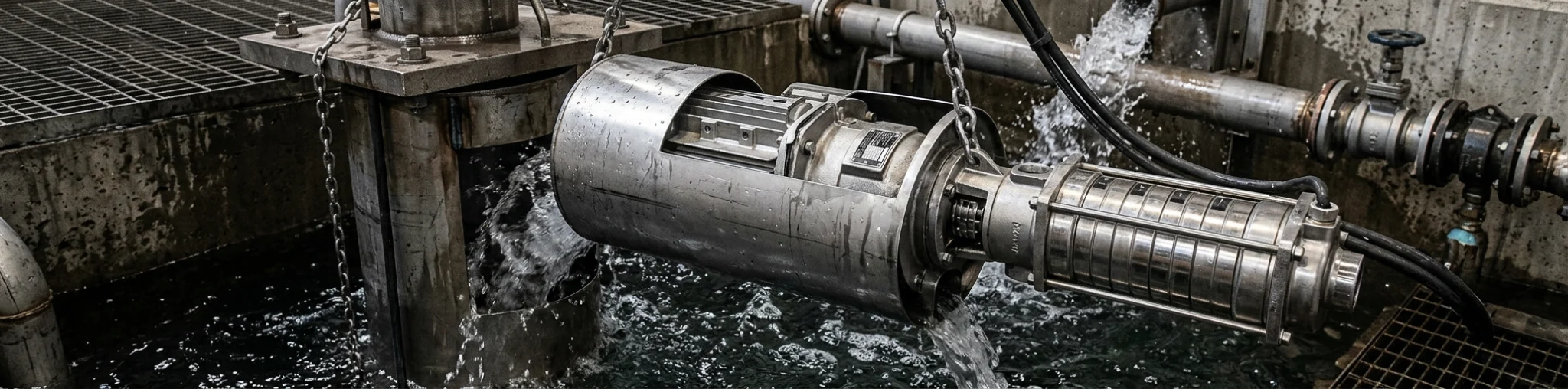
The annulus goes still the moment casing ID exceeds the motor can and the intake sits above the stator. Warm borehole water sits against the windings instead of sweeping heat off the shell, and a set that looks healthy on the curve starts cooking insulation. We hang cooling shrouds so flow is forced past the motor, not left to drift in a dead pocket. Our shrouds match the diameter, intake height and actual hole temperature, not a datasheet assumption. Without that sleeve the stator overheats, trips climb, and the rewind arrives before the first service.
A submersible pump cooling shroud is the sleeve we put around the motor so every litre the pump pulls has to travel down the outside of the can before it turns into the intake. Call it a flow sleeve if that is what is written on the drawing. Same job. Force water along the motor so the stator can dump heat.
We hang these on WA bores, dewatering strings and the odd irrigation hole where someone opened the casing two sizes for gravel pack and then forgot the motor still needs velocity. If you are the bore contractor or the site fitter landing the pump, this is the check before you make up the rising main.
The Motor Can Only Cool in Moving Water
The oil or water inside the motor can carry heat from the windings to the shell. The shell only dumps that heat if water outside is moving. Standing water in a fat annulus is an insulator. Surface temperature climbs, insulation class gets eaten, and the set trips or dies quietly a season later.
Minimum velocity along the can is the number that matters, not “it looks wet down there.” Most four-inch and six-inch motors want something in the order of 0.15 to 0.5 m/s past the shell, depending on make, water temperature and how hard you are loading the stator. Warm groundwater knocks the margin down. A long motor can need more length of forced flow, not less.
If the casing ID leaves a wide annulus, natural flow past the motor is a trickle even when the pump is on duty. The water the pump wants comes from above the intake. The motor sits in a dead pocket. That is when we add the shroud.
What the Shroud Actually Does on the String
The shroud is a tube, closed or necked at the bottom, open at the top, sized to the motor can with a tight-ish annulus of its own. We clamp or thread it so the motor hangs inside. Suction now has to come from above the top of the sleeve, travel down between shroud and can, then turn into the intake.
That forced path is bore pump motor cooling. No path, no cooling, even if submergence looks generous on the dip tape.
Length has to cover the full motor, not just the top third of the can. A short sleeve that leaves the lower windings in still water is decoration. We also need a way for sand and scale to drop out rather than pack the annulus solid. A shroud that silts up is a heater jacket Pump controls.
On our jobs the sleeve is stainless or the same material as the column so it survives the hole. Permaglass column above it is common on corrosive groundwater. The shroud itself still has to take the mechanical hang and any knock on the way in.
When the Casing ID Makes a Shroud Mandatory
Open the hole and measure. Casing ID versus motor OD is the first decision, not the pump curve.
A 4 inch motor in 100 mm casing already has a tight annulus. Flow velocity is usually enough if the intake is below the motor, which it is on a standard borehole pump. A 4 inch motor in 150 mm or 200 mm casing is a different animal. The annulus is a lake. Velocity collapses. We shroud it.
Same story on 6 inch and 8 inch cans in mining and dewatering casings that were drilled for screens, gravel and a future bigger set. The hole was never sized around this motor. The motor still has to live in it.
If you can pass a hand between can and casing in your head, assume you need a flow sleeve until the numbers say otherwise. Guessing from “we’ve always hung them like this” is how windings get cooked in summer when the water table drops and temperature rises.
We spec submersible borehole pumps with the shroud as part of the string when the casing is oversized, when the intake is above the motor, or when both happen on the same hang. That is selection work, not an extra on the docket after the pump is already on site.
Intake Above the Motor: Dewatering and the Inverted Hang
Standard borehole layout: motor at the bottom, pump stages above, intake between them, water coming from the screen around and below. Flow already washes the can on the way up to the intake if the annulus is tight.
Dewatering and some wellpoint-style hangs flip that. Pump on the bottom of the hole, intake at the top of the pump, motor underneath in a sump. Water never has to pass the can to reach the intake. The motor sits in a still pocket even in a snug casing.
That is a shroud job every time. The sleeve extends above the intake so water is drawn from higher in the hole, down the motor, then into the pump. Without it you have full submergence and zero cooling flow.
APT Water sees this on mine dewatering, basement packages and the occasional irrigation sump where someone stood the set on the floor of a wide wet well. Wet well is just an oversized casing with a lid. Same physics. Same sleeve.
Flow Past the Motor: Do the Velocity, Not the Vibe
You need a number. Flow through the pump, divided by the cross-section of the annulus between shroud and motor can, gives velocity. Keep that velocity in the motor maker’s band at the lowest duty you will actually run, not at the best-efficiency point on a fresh curve.
Low-flow protection matters here. If the set can run out on a nearly closed valve, or the bore yields drop in autumn, velocity in the sleeve falls with the flow. The windings do not care that the pump is “only ticking over.” Heat is still being made. The cooling has gone.
We treat low-flow bore pump protection as part of the same conversation as the shroud. A flow switch or a well-probe cut-out that stops the set before the annulus goes lazy will save a motor the sleeve cannot save on its own.
Water temperature is the other lever. Twenty-five degree groundwater is one problem. Thirty-five degree water in a shallow dewatering hole in February is another. The cooling capacity of the film on the can drops as temperature rises. Some makers derate or demand a shroud above a stated water temperature even in a tight casing. Read the motor sheet for that hole, not a generic catalogue page.
Sand, Scale and a Blocked Annulus
WA bores bring sand. New holes bring drilling fines. Old holes bring scale and iron. All of it wants to live in the gap between shroud and can.
A packed annulus is worse than no shroud. Water stops. Heat stays. You pull a motor that looks fine on the outside and the windings are toast.
We keep a drain or a generous bottom clearance so solids can fall through rather than bridge. On sandy holes we talk about shroud ID, not just “fit the can.” Too tight and it blocks. Too loose and you lose velocity. That is a sizing decision, not a clamp-and-hope on the back of the ute.
Intake screening still matters. The shroud does not replace a proper intake. It only redirects flow. Sand that gets through the intake still cuts the pump. Sand that never reaches the intake because it settled in the sleeve still kills cooling.
If the hole is known for fines, we would rather oversize the cooling path slightly and keep velocity with a longer sleeve than run a paper-thin gap that silts in a week.
Submergence, Rising Main and the Rest of the Hang
The shroud does not replace submergence. NPSH and inlet drownings are still your problem. The sleeve only fixes the film on the motor can.
Check that the top of the shroud stays below pumping water level at the worst drawdown you will see, with margin. If the water level drops into the sleeve, you are sucking air and boiling the can at the same time.
Rising main, column and shroud have to make up as one string. Permaglass bore casing and pump column is what we hang in aggressive groundwater so the column is not the thing that fails first. The shroud still needs a mechanical joint that can take the weight of the motor and the knock of landing. A pretty sleeve with a weak clamp is a drop in the hole.
Cable path needs thought. Power cable and earth have to pass the shroud without being pinched or wearing through on a sharp edge. We run the cable outside the sleeve or through a proper slot, never jammed in the cooling annulus. That annulus is for water.
Casing ID, Motor Can and the Drawing We Actually Use
Before anyone cuts stainless, we want:
– Casing ID and stick-up – Motor OD, length and maker’s minimum velocity – Pump duty at the real head, including the low-flow end – Water temperature in summer, not the one measurement from the test pump in July – Screen or intake level versus motor level – Sand and chemistry notes from the hole
From that we pick shroud ID, length and material, and we check the velocity at min flow. If the numbers do not close, we change the motor frame, change casing plan, or we do not hang that set in that hole.
This is the same work we do on bore pumps for Perth groundwater when the hole is a domestic or small commercial bore with an oversized PVC string. The physics does not change because the client is a farm instead of a pit. Fat casing, small can, warm water: shroud or a different hang.
When We Size the Set Instead of Guessing on the Pad
You can fabricate a sleeve on site that looks about right. Plenty of fitters have. Some of those motors are still running. The ones that are not were the warm holes, the sandy holes and the sets that spend half the day at low flow.
We would rather size the cooling path with the pump. Motor can, shroud annulus, minimum flow and temperature belong on the same sheet as impeller trim and rising main friction. If the only way to keep velocity is to run more flow than the bore will yield, the answer is not a tighter sleeve. The answer is a different motor, a different duty, or a control that will not let the set loaf.
Call that out before the crane is booked. Pulling a cooked submersible because the annulus was a guess is a two-day job and a new stator. Putting the shroud on the drawing is an afternoon.
If the casing is already in the ground and you are stuck with it, send us the ID, the motor you have and the duty. We will tell you whether a flow sleeve closes the cooling, or whether that can should not go in that hole.
Fit Notes Before You Land the Pump
Land the shroud square. A cocked sleeve rubs the can, wears the shell and kills the annulus on one side.
Do not leave the bottom of the motor sitting on the shroud floor. You need water to turn into the intake and solids to drop. A motor hard on the bottom plate is a blocked jacket waiting to happen.
Check rotation and start current after the hang the same way you always do. A shroud does not change electrical faults. It only changes whether the can can throw heat once the set is in the water.
If you are commissioning into a new bore, run it and then pull the first hours of sand through with eyes on the sleeve. A new hole will move fines. Better to know the annulus is still open before you walk off site.
Keep a record of shroud ID, motor serial and the velocity you calculated. Next time someone pulls the set they should not have to reverse-engineer why there is a bit of pipe around the can.
Warm water, oversized casing, intake above the motor: those three are the triggers. If any one of them is true on your hang, we treat bore pump motor cooling as a design item, not a hope. A submersible pump cooling shroud is the hardware. The decision is whether the film on the stator will still be moving when the hole is at its worst, not when you first drop it in on a cool morning.
Warm water or an intake above the motor means the shroud belongs in the next drop pack. Send the hang sheet when you contact us, then keep that shroud on the next drop rather than a later variation.