

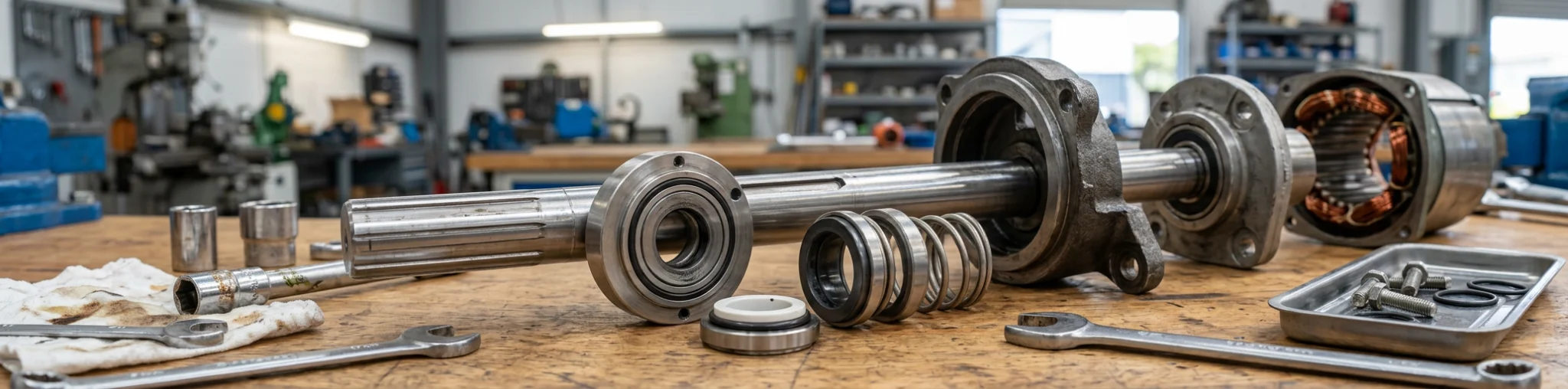
Oil in the sample jar turns milky within hours of start-up when the mechanical seal has let aquifer water into the motor. That interface is the only barrier between the hole and the oil bath, and once it weeps the winding insulation starts to go. We treat seal selection as a duty decision: sand load, temperature, start-stop frequency and the pressure across the faces. Our sets go down with the right faces, springs and elastomers for the water in that bore, plus a start procedure that does not dry-run the seal. Prevention is cheaper than a rewind and a lost column.
The seal does not fail in theory. It fails in the casing, in the annulus, on a VFD ramp, or because the shroud never gave the motor the cooling flow it needed. Pump seal protection starts at spec and finishes in the way you land the column on the headworks.
What the Mechanical Seal Is Doing Down the Hole
A submersible borehole pump uses a mechanical seal (often a pair) to keep pumped water out of the motor and, on oil-filled units, to keep oil in. Faces run against each other with a microscopic film of fluid. Springs, bellows or a rubber boot hold that film. If the film flashes, the faces score. If grit gets between them, they groove. If the set runs dry, they glaze and crack.
On a WA bore the seal lives in a hostile envelope. Water can be hot, sandy, or chemically aggressive. The rising main and Permaglass column hang a long string. The annulus between pump and casing is your cooling jacket, until it isn’t. Wet-well drainage pumps see a different mix: rags, silt, and stop-start duty that never lets the faces bed in.
We still see people treat the seal as a consumable they will “get to later”. Later is a crane, a wet well isolation, and a motor that has already ingested water.
What a Failed Seal Looks Like When You Pull the Set
You do not need a lab. You need the oil, the faces, and the first few metres of winding.
Milky oil is the classic. Emulsion means water has crossed the seal. A burnt, varnish-dark oil with no water can still mean the faces ran hot and the oil cooked. Sand packed in the seal housing means the annulus or the intake was feeding grit straight onto the faces. A cracked ceramic or silicon-carbide ring with a radial star pattern is thermal shock, often dry run or a sudden hot-to-cold slug.
On the motor, look at the lower bearing and the winding ends. Water that got past the seal does not sit politely in the oil chamber. It finds the bearing and then the stator. By the time the earth-leakage trips, the seal has already done its damage.
On the hydraulic end, a leaking seal can also mean product water in the wrong place, contamination of a potable bore, or a drainage pump that is recycling dirty water around the wet well instead of lifting it.
Photograph the faces, bag the oil sample, and tag the depth, duty and VFD settings. That record is what stops the next hang repeating the same submersible pump mechanical seal failure.
Dry Running, the Fastest Way to Destroy a Face
The film on the seal faces needs liquid. No liquid, no film. Seconds of dry running will glaze a carbon face and crack a hard face. On a new hang, dry running happens more often than anyone admits.
The bore has not recovered. The start-up procedure ramps the VFD before the column is primed. Someone opened the headworks isolation against a closed valve and thought the pressure gauge would save them. The low-level probe in the wet well was set against a false stilling tube reading. The shroud was omitted on a slimline pump in a large casing, so the motor saw almost no velocity past the stator, and the seal saw heat it was never designed for.
NPSH margin is not only about cavitation in the impeller. A pump that is starving at the eye is also starving the seal of a stable liquid film. Cavitation hammering travels. Faces that chatter do not last.
We treat the first start as a seal event, not just a hydraulic event. Confirm water over the intake. Confirm the shroud (where the casing ID needs one) is on and oriented. Confirm the VFD minimum speed still moves enough flow for motor cooling and for the seal. Confirm the low-level cut-out actually sees the water, not a trapped air pocket in the annulus.
If the set has been sitting on the skid in the sun, the oil and the faces are already hot before they see water. Give them a wet start, not a thermal shock.
Grit, Sand and What WA Aquifers Do to Faces
Abrasives are the second killer. Fine sand in the annulus, silt from a developing bore, or scale from an old steel casing will roll between the faces like grinding paste.
Pump seal protection against grit is not a magic face material. It is the intake position, development of the bore, grading of the pack, and whether the pump is sitting in a sump of fines. A shroud that is too short, or a pump landed in the rat hole, will feed the seal a constant slurry.
APT Water specifies harder faces (silicon carbide on silicon carbide, or similar pairings suited to the water) when the bore is known to make sand. That is not a substitute for fixing the sand. Hard faces last longer in grit; they still fail if you pump a cutting slurry 24 hours a day.
Permaglass casing and column help on the corrosion and weight side, and a clean, smooth ID is kinder to centralisers and to the annulus flow. They do not stop a poorly developed bore from making sand. If the cuttings are still coming, the seal will tell you on the next pull.
Drainage and packaged pump systems in pits see a different abrasive: grit plus stringy solids. A cutter or a proper strainer and a seal with a flushed or protected housing lasts. An open wet well with no stilling and a pump sitting in the sludge does not.
Heat, VFDs and Cooling Through the Annulus
Heat kills seals two ways: it flashes the film, and it cooks the elastomer. WA groundwater is often warm. A motor in a tight annulus with no shroud, or a VFD turned down so far that flow past the stator collapses, will push the seal past its temperature rating.
VFD duty is now normal on our packaged pump systems and controls. That is fine if the minimum frequency still delivers cooling flow and if the ramp does not dwell in a band where the pump is running but not moving water. A long ramp against a closed valve is a dry-run analogue for the seal even if the wet well is full.
Check the motor’s required cooling velocity against the casing ID and the shroud. If the annulus is large, the shroud is not an optional decoration. It is pump seal protection. If you cannot get velocity, you cannot claim the seal was “in spec”.
Thermal cycling from stop-start on a hot bore is hard on bellows and O-rings. If the site engineer wants six starts an hour, say so at design. The seal and the motor oil need that duty written down, not discovered after the first summer.
Hang Errors: Column, Headworks and the Way the String Sits
A mechanical seal that was perfect on the bench fails if the pump is bent, side-loaded, or hanging off-centre in the casing.
Column joints that are not square, a rising main that takes a kick at the headworks, or a torque-arrestor that lets the set spin and then snatch, all put radial load into the seal. The faces need to stay coaxial. They do not stay coaxial if the pump is leaning on the casing wall.
We care about how the Permaglass column is made up, how the spider or centralisers sit, and how the headworks take the weight and the thrust. A cocked flange at the surface is a cocked pump at 80 metres. You will not see it until the seal weeps.
Cable routing in the annulus matters. A cable that is jammed, or a splice that catches, can rotate the set on the way down and wind a twist into the string. That twist becomes side load when you land.
On a skid-mounted packaged set the same logic applies: pipe strain into the volute is seal load. Support the pipe. Do not use the pump as a pipe anchor.
Faces, Springs, Oil and the Protection That Actually Lasts
Pump seal protection is a stack, not a sticker.
Face pair: matched to the water (clean, sandy, aggressive). Elastomer: matched to temperature and chemistry. Spring or bellows: able to live with the solids and the duty cycle. Oil: the right grade, the right fill, no moisture from day one. Housing: a design that does not let sand sit on the faces.
Double seals with an oil or barrier chamber give you a warning. The outer seal takes the aquifer; the inner seal takes the oil. A moisture probe or an oil-condition check tells you the outer has gone before the motor drinks. That is worth the extra millimetres on a deep, expensive hang.
We still fill and check oil as if the seal depends on it, because it does. Overfill can over-pressure the seal. Underfill leaves the faces and bearings short of lubrication. Contaminated oil from a dirty funnel is a failure you cannot blame on the aquifer.
For drainage pumps in a wet well, a seal-failure probe wired into the controls is not luxury. It is the difference between a seal kit and a rewind.
Inspection Before You Send It Back Down
Do not guess. Open what you can, and look.
Check axial play, the oil, the faces if the design lets you, the cable entry, and the shroud. Spin the shaft by hand. Grit in the seal area is a reason to strip, not a reason to “run it and see”. Our notes on tips for inspecting your submersible pump are the checklist we actually use on the bench and on the headworks, faces, oil, cable and hang geometry, not a once-over with a rag.
If the bore made sand last season, budget a face replacement even if the oil looks clean. Sand damage is often one season behind the oil sample.
Log running hours, starts, VFD min/max, and any low-level trips. A seal that failed after a weekend of dry running is not a “bad seal”. It is a control and level problem.
Spec the Next Pump So the Seal Has a Chance
A lot of submersible pump mechanical seal failure is bought at tender. Wrong diameter for the casing. No shroud. A motor that cannot cool at the VFD turndown the site wants. A cheap face pair in a sandy bore. No moisture probe. NPSH ignored it because “it always worked in the last bore”.
When you are still choosing the set, walk through the 4 key factors when buying a submersible pump with seal duty, cooling, NPSH and the actual water quality on the table. Flow and head alone do not keep water out of the motor.
Match the pump to the casing and the annulus. Match the column and Permaglass string to the hang and the headworks. Match the controls to the seal, low-level, dry-run timers, minimum speed, and a probe if the motor oil is the last barrier.
If the job sits on a Water Corp scheme, read the Water Corporation suppliers and contractors requirements before you lock the skid, the headworks and the pump set. Their contractor and product rules sit alongside the hydraulics, and a seal-related pull is harder to explain when the hang never met the scheme’s expectations.
We design, supply, install and service the string, submersible borehole pumps, Permaglass bore casing and pump column, packaged pump systems and controls, as one duty, because the seal does not care which trade “owns” the failure.
What We Want You to Do on the Next Hang
Treat the mechanical seal as a commissioning item, not a spare in the tray.
Before you land the pump: confirm shroud, centralisers, oil fill, face type against the water sample, and that the VFD minimum speed still cools the motor in that casing. After first start: check for vibration, check the headworks for leaks, and if the design allows, check oil or the moisture probe within the first run hours, not at the next planned service.
If you are the fitter or site engineer on the next WA hang, pull last season’s oil sample and face photos out of the job folder and put them next to this year’s spec. If the last set failed on grit or dry run, change the hang, the shroud, the level control or the face pair before the crane leaves. That is the practical step. The seal will not get a second chance once the column is made up and the rising main is in the hole.
If last season’s faces failed on grit or dry run, change the hang, shroud and face pair before the crane leaves. Put those photos with the enquiry and contact us while the column is still on the pad.