

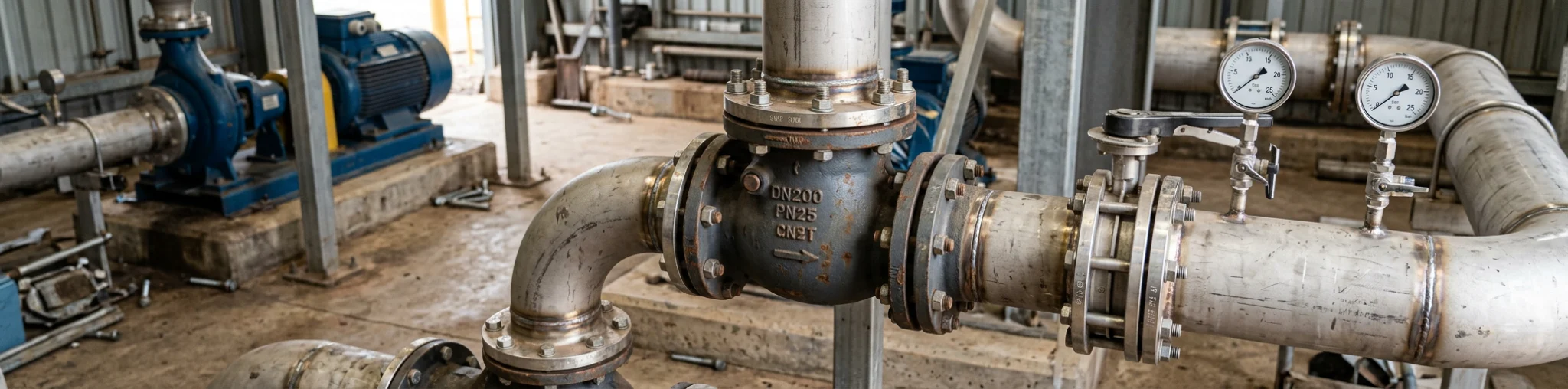
The rising main jumps in the clamps before any valve is touched, and the check has already taken the slam. A water hammer in a bore rising main is a pressure wave, not a noise complaint, and the clapper or spring is the first thing it finds. We size and locate non-return valves for the column length, the shut-down ramp and the static head sitting above the set. Our headworks get a surge allowance, controlled stops and a check that can survive the reverse flow. Ignore that wave and the body cracks, the seat cuts, and the next start lifts a leaking column.
That noise is not “just the set stopping.” It is a pressure wave running the full length of the bore rising main, reflecting at the headworks and coming back down onto the same disc, seat and hinge that you hung last shutdown. Water hammer bore rising main events do not need a burst to be doing real work. They eat check valves first.
We hang and pull these sets across WA. When a hydraulic fitter or site engineer calls us after a trip, the story is almost always the same: the pump still spins, the shroud is intact, the motor insulation looks fair, and the non-return will not hold. That is bore pump check valve damage, and it starts in the column, not in the wet well.
The Slam You Already Know at the Headworks
You stop a submersible borehole pump and the water in the rising main still has mass and velocity. It wants to keep going. Gravity and the static column then reverse it. The check valve is the only thing that is supposed to catch that reverse flow before it spins the wet end backwards or dumps the column back down the casing.
If the disc is late, or the spring is tired, or the valve is a cheap swing type hung in a long Permaglass column, the reverse flow is already moving when the disc hits the seat. That is the slam. The pressure spike is not a slow rise you can watch on a gauge at the skid. It is a wave. Peak pressure at the valve and at the first few column joints can sit many times above the duty head you designed for.
You feel it as a bang in the headworks. You see it later as a weeping joint, a cracked disc, a flattened seat, or a hinge pin that has ovalled the body. One event can start it. Repeated VFD trips, power drops and across-the-line stops finish it.
How Water Hammer Forms in a Bore Rising Main
Think of the rising main as a closed pipe full of water, from the pump discharge up through the column, through the headworks, and out to the first air vessel or open discharge. When flow stops suddenly, the Joukowsky rise is a function of wave speed, velocity change and fluid density. Deep WA bores give you a long column. A long column means a long travel time for the wave and a lot of stored momentum.
The steel column is stiff. Wave speed is high. The spike is sharp. Permaglass bore casing and pump column is a different animal. The modulus is lower, so the wave speed drops, but the column itself stretches and the joints work. You trade a slightly softer spike for movement at every coupling. Either way the check valve still has to close against reverse flow.
Air in the column makes it worse, not better. A pocket under the headworks or in a high point of the rising main compresses on the upstroke and dumps energy on the downstroke. Sand in the annulus or in the column scoring the disc face means the valve never quite seats, so reverse flow is already established before the slam. Low static after a dry season means more air drawing into the column on a long stop. You are not running a clean, short factory test loop. You are running a bore.
NPSH at the eye still matters on start, but hammer is a stop problem. The pump can have plenty of submergence and still destroy the non-return every time you kill power.
Why the Check Valve Takes the Hit Before the Pump
The motor and wet end sit below. They see a change in load and, if reverse rotation starts, they see torque the wrong way. The check valve sits in the flow path that has to reverse. It is the first moving part that must go from open to shut while the column is still alive.
On a typical hang we see the non-return at the pump discharge, sometimes a second valve in the column, sometimes only a headworks NRV. If the only check is at the headworks, the entire rising main is a falling weight onto that seat. If the check is at the pump, the disc is trying to shut in the most violent part of the reverse-flow window, right where velocity is highest as the column collapses.
Disc materials crack. Resilient seats take a set. Spring-assisted valves lose rate after a season of slams. Swing checks flutter on VFD ramps then hammer on a hard trip. Once the seat weeps, every subsequent stop has more reverse velocity before closure. That is the cycle that turns a serviceable valve into a write-off.
APT Water pulls columns where the pump looks serviceable and the check valve is in pieces. The shroud is fine. The casing in the hole is fine. The damage is localised at the valve because that is where the wave is forced to stop the mass.
Column, Casing, Annulus and What the Wave Does on the Way Up
The wave does not only live at the valve. It travels. At every column joint you get a reflection. At the headworks you get a hard reflection unless there is a genuine air vessel or a controlled discharge path. Clamps and saddles take a shock load. Threaded or coupled joints work. The permaglass column can oval or weep at the sockets if the surge is repeated.
The annulus between casing and column is not a spectator. If you have flow or pressure communication, a leaking joint, a damaged shroud, a poorly seated pump, the surge can move water in the annulus as well. That scours, it lifts fines, and it can change the next start. Casing that was sound at hang can show movement at the headworks after a season of hammer.
You already know a rising main is not just a “pipe.” It is the structural and hydraulic link from the wet end to the skid. Treat it as a spring-mass system and the check valve is the stop at the bottom. Ignore that and you will keep replacing discs.
VFDs, Hard Stops and the Reverse-Flow Window
A VFD that ramps down gives the disc time to follow the flow toward shut. An across-the-line stop, a phase loss, or a protection trip does not. The reverse-flow window is the time between “flow through the valve is still forward” and “flow is reverse and accelerating.” Shorten that window with a controlled stop and the valve closes on a trickle. Open that window with a hard kill and the valve closes on a moving column.
We still see packaged pump systems and controls set up for start current and dry-run, with nothing useful on stop. Low-flow protection, underload, and level probes save the motor. They do not automatically save the check valve. If your stop is a contactor drop, assume a hammer until you prove otherwise .
A ramp-down that is too slow on a high static can also cause trouble: the pump runs on in a low-flow region, heat builds, and then a protection trip does the slam anyway. Match the stop to the column length and the static. That is site work, not a catalogue setting.
For the wider duty, irrigation, process, building services, the same physics shows up whenever we design and hang water pump solutions for Perth commercial needs. Bore or packed set, if you have a rising main and a check valve, you have a hammer path.
What We Find When We Pull the Set
You already know the look. Disc face hammered. Seat extruded. Hinge pin wear. Body cracked at the stop. Spring coils closed up. Sometimes the valve is still in one piece and simply will not hold a column overnight. That last one is the weeper that trains the next slam.
We also find column joints that have worked, headworks fittings that have backed, and pressure gauges that have been spiked to death. The pump may show signs of reverse rotation, loosened impellers, scored thrust, but that is downstream of the valve failure, not the cause.
Sand scoring on the disc tells you the annulus or the formation is in the flow. Air scoring or a pitted seat tells you the column is breathing. Neither is a reason to keep the same valve and the same stop method.
When we rehang, the valve choice follows the column, not the other way around. Spring-assisted, full-flow, rated for the slam you will actually get, with a seat you can service. Hang it where it can close before the reverse velocity builds. That may mean at the pump, it may mean a second valve, it may mean both plus a controlled stop.
Low flow is a separate killer, sanded inlets, dropping water, throttled discharge, and it overlaps with hammer because a set that is already hunting will trip. That is why we treat low flow bore pump protection as part of the same hang, not an add-on after the first burnt stator.
Drinking Water, Non-Return and Why the Seat Has to Hold
If the bore is supplying a potable system, a weeping check valve is not only a mechanical problem. Reverse flow and stagnation in the column change what you deliver at the headworks. You already work to keep the rising main full and the non-return honest. The Australian Drinking Water Guidelines are the reference we use when the duty is drinking water: multiple barriers, no uncontrolled backflow, and a system you can actually keep clean. A slammed, leaking NRV is a hole in that barrier.
You do not need a lecture on guidelines to know a column that dumps back into the bore on every stop is dragging whatever sits in the casing and annulus back through the wet end. Hold the column. That is the job of the valve you are about to replace.
Permaglass, Steel and How the Hang Changes the Surge
We supply and hang both. Steel column, high wave speed, sharp spike, joints that like to leak at the thread if they have been worked. Permaglass column, lower wave speed, more stretch, sockets that like to weep if the surge is a daily event. Neither material forgives a check valve that closes late.
Shroud clearance, pump seating, and centralising in the casing all change how the set starts and how debris sits around the discharge. A shroud that is packed with fines will not cause a hammer by itself, but it will change the flow into the first metres of column and it will make the next pull harder. Get the hang right so the valve sees clean, full-bore flow, not a jet against one side of the disc.
Headwork design matters as much as the valve. A rigid dead-end at the surface reflects the wave at full strength. An air vessel that is waterlogged is a dead-end that pretends to be a cushion. Drain legs, sample cocks and gauge snubbers all see the spike. If you keep replacing gauges, you already have a hammer.
Packaged Controls, Skids and What We Set on Stop
On a packaged pump system the skid looks tidy and the column is still a weapon. Controls that only look at current, dry-run and high pressure will not catch a slam. We set stop ramps against column length and static. We look at whether a trip still hard-kills the set. We look at whether there is a genuine non-return at the pump as well as at the headworks.
You can have a beautiful VFD panel and still hammer the valve if emergency stop and protection trips bypass the ramp. Decide, on paper, what happens on phase loss. That is the event that writes off discs.
Drainage pumps and wet well sets have their own check-valve slam, shorter main, often a heavier disc, but the bore rising main is the long one. Do not copy a wet well NRV into a 80 m column and expect it to live.
What You Do on the Next Shutdown
Do not wait for the next bang. On the next planned stop, isolate, drop the column far enough to pull the check valve, and put the disc, seat and hinge on the bench next to the last service sheet. Measure disc travel. Look for a set in the seat. Look for an oval in the pin bores. If it weeps on a simple column-hold test, it is already training for the next slam.
Write down column type and length, static water level, how the set is stopped (ramp, contactor, protection trip), and whether there is a second NRV at the headworks. Bring that to us before you rehang. We will match the valve and the stop to that rising main, not to a catalogue duty.
That is the job: hang a set that still holds a column after a hard trip, with a check valve that closes on a trickle instead of a wave. You know the sound at the headworks. Stop letting that sound write off the valve.
You already know the slam at the headworks. Send the trip notes when you contact us, then size the next check valve for a trickle, not a wave.