

Sand can be easy to see in a sample and difficult to interpret. It may settle in a container, make water look cloudy or appear after a change in pumping conditions. That does not mean the bore pump has failed, nor does it prove that the bore itself is defective. It does mean particles deserve attention before they continue through a pumping system.
The risk from sand in bore water is cumulative. Fine abrasive material can pass through narrow hydraulic spaces, contact moving surfaces and alter how a pump performs over time. The appropriate response depends on where the particles are coming from, when they appear and what the operating evidence shows. It is not a matter of applying one sand limit or changing a pump on the strength of a visual observation.
For a bore system, the useful starting point is to trace the particles from the source to the pump set, then separate what may be happening in the bore from what can happen to equipment downstream. This article explains that path, the signs that need investigation and the records that can support a measured next step.
Particles Begin as a Bore and Operating Condition
A bore is intended to admit groundwater while controlling the movement of formation material into the water path. Its construction, screen and gravel-pack arrangement, development history and current condition all influence that outcome. Sand in a new bore may be associated with development. In an established bore, particles can also relate to changes in the screen or gravel pack, the bore condition or the way the bore is being pumped. Those are possibilities to investigate, not conclusions that can be made from the water alone.
The pumping rate and pumping water level matter because they describe the condition under which water is being drawn towards the bore. A particle issue that appears only at a particular flow, after a longer run or at a lower water level may provide a valuable lead. It still needs to be considered with the bore record and test information. Sustainable bore yield is a source question. It is separate from the system’s total dynamic head, the pump curve and the pump’s motor-cooling requirements.
Start by preserving the history rather than relying on a one-off look into a bucket. Note whether the material is seen at start-up, throughout a run or only after operating conditions change. Record bore age and known construction details, the pump setting in relation to the screen and pumping water level, and any previous drilling, rehabilitation or component work. A bore log may hold useful information about depth, soil layers, yield and the installed pump, but it does not replace current testing.
What Sand Does Inside a Submersible Pump
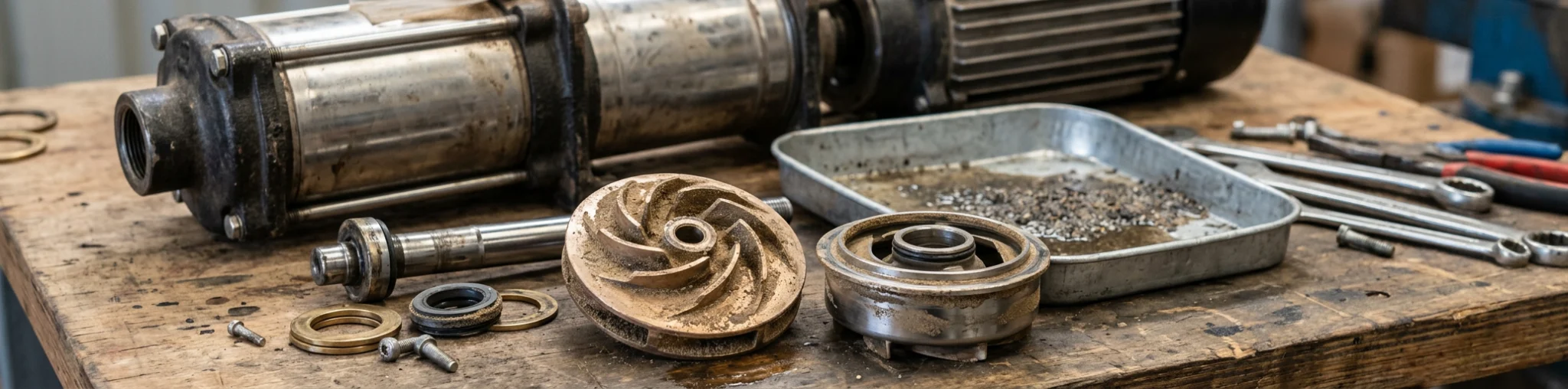
Most bore pumps use hydraulic stages to add energy to water. As water moves through the pump, it passes across impellers, diffusers and other internal clearances. Abrasive particles carried with that water can contact those surfaces. The resulting wear pattern depends on the particle characteristics, water conditions, operating point, pump construction and the specific components involved. It is not identical across every pump design.
Fine material can erode or wear surfaces that are designed to work at close clearance. As clearances change, some of the water being moved through a stage can recirculate internally rather than contributing as effectively to discharge. The pump may then require more attention to maintain the same hydraulic result, or show a decline in flow or pressure under comparable conditions. Extensive sand wear can eventually require replacement of internal components such as impellers and a shaft, but the condition of retrieved parts needs to be assessed in context.
Particles may also collect or interfere at points where the hydraulic path is already sensitive to deposits or wear. That can add to an unstable operating picture, particularly when it is combined with a changed bore condition or an operating duty outside what the source can sustain. It should not be confused with a universal statement that every particle produces the same failure route.
Where a submersible pump relies on water moving past its motor for cooling, the installed arrangement also needs its own review. Pump position, flow past the motor and the applicable manufacturer instructions affect that question. Sand wear, bore yield, hydraulic duty and motor cooling are related system concerns, but they are not interchangeable checks.
Read Performance Changes as Clues, Not a Verdict
Reduced output, irregular flow, unusual noise, overheating indications or visible silt can justify investigation. None of these symptoms proves bore pump damage on its own. A pressure change could be associated with wear, but it can also reflect pipework, control, power, measurement or demand changes. A noisy pump may have a hydraulic, mechanical or electrical issue. The job is to build an evidence set that distinguishes the possibilities.
Use the same operating case for comparison where possible. Record flow and pressure, the pumping water level and drawdown, current or power, run time, control state and protection or trip history. A change has more value when the measurement location, instrument and operating condition are known. Pair these records with consistently collected water samples so that the particle trend can be assessed rather than inferred from one casual sample.
An inspection can add another layer of evidence when it is carried out safely and by suitably qualified people. The submersible-pump inspection guidance is a useful reader pathway for recognising signals such as reduced output, unusual noise and visible material. It is not a remote diagnosis or an instruction to work on electrical or suspended equipment without the required controls.
Photos and notes from a retrieved pump set can be especially helpful. Record the location and character of wear before cleaning parts or discarding them. Compare that record with water samples, operating trends and the current manufacturer limits for the exact pump. Relevant range information may include the published e-GS series wear-resistance design and the range-specific Z6/ZN6 sand-handling claim, but neither replaces evidence from the installed equipment. A worn component confirms that a component has been worn. It does not, by itself, establish the source of every particle or the full cause of a change in performance.
The broader APT Water information pathway can help readers place those product details within the complete bore and application context. Any project discussion should still begin with documented bore, water and duty evidence rather than an assumed product answer.
Keep the Bore Cause Separate From the Equipment Consequence
It is tempting to solve a particle problem at the pump. However, equipment changes cannot by themselves correct an unstable source condition. If the bore is releasing material because of its development, screen, gravel pack, pumping rate or another upstream condition, the investigation needs to address that cause as well as the consequences for the pump and pipework.
This distinction protects against two costly assumptions. The first is that a new pump will remain unaffected when the source condition is unchanged. The second is that a worn pump proves the bore has collapsed or was constructed incorrectly. Both claims reach further than the evidence allows.
The right sequence is to protect the system where appropriate, test and document the water and operating condition, inspect evidence when access and safety arrangements allow, then correct the identified source or system issue before considering equipment changes. That sequence may involve bore specialists, pump personnel and electrical personnel with different responsibilities. It is deliberately evidence-led because a pump that is asked to operate above sustainable bore yield is not made suitable by controls alone.
Abrasion Features Must Stay Attached to the Exact Product
Pump designers can use materials and component arrangements intended to manage abrasive exposure. That is evidence that sand is a design concern, not proof that a pump is immune to it. Product claims need to remain tied to the named range and current manufacturer information.
For example, APT Water publishes the e-GS series with a floating-impeller design described as enhancing wear resistance. That is a useful design feature to consider for that exact range. It does not provide a universal concentration limit, confirm its suitability for a particular bore or remove the need to understand the particle source.
Similarly, the Z6/ZN6 range includes a sand-handling claim for that specific range. It should be assessed against its current product documentation, the actual particle conditions and the rest of the duty. A sand-handling feature cannot repair a defective bore, stabilise an unsuitable pumping rate or substitute for water and bore evidence.
Selection must also keep separate checks separate. Bore yield and drawdown indicate what the source can sustain. Total dynamic head describes the system demand at a flow. The pump curve tests a particular pump configuration against that duty. Motor cooling, water chemistry and component compatibility each need their own evidence. Treating an abrasion feature as a shortcut across all of those questions can create false confidence.
Build an Evidence Pack Before Choosing a Response
The most useful enquiry or site review starts with comparable information. It lets the people involved test a hypothesis instead of treating symptoms as certainty.
- Collect water samples using a consistent method and arrange appropriate analysis. Keep a trend of particle observations rather than relying on an isolated clear or sandy sample.
- Assemble bore information: age, available bore log, construction details, screen and gravel-pack information, known changes and the pump setting relative to the screen and pumping water level.
- Capture operating records at the same or clearly stated conditions: flow, pressure, drawdown, current or power, control state, trip history and run duration.
- Retain photos and notes of retrieved components, including where wear appears. Obtain the current manufacturer information for the exact pump before interpreting that evidence against a limit.
- Identify what changed before the issue appeared, such as a different operating pattern, a change in water level or recent work on the bore and system.
These records do not guarantee a final diagnosis. They make the next review more focused and reduce the chance of replacing a component without addressing the condition that is sending abrasive material through it.
If you need to contact us with bore and operating evidence, include the bore details, water-sample trend, pump identification, pumping water level, flow and pressure records, drawdown, current or power history, and photos of any retrieved wear. That material supports an informed discussion and any necessary testing. It does not replace site assessment, current manufacturer documentation or final project design review.
Frequently Asked Questions
Does Visible Sand Always Mean the Pump Is Damaged?
No. Visible sand is an investigation signal, not proof of damage. Compare consistent water samples with operating trends and, where available, retrieved-component evidence before drawing a conclusion.
Can a Sand-Handling Pump Fix a Bore That Produces Particles?
Not by itself. A range-specific abrasion or sand-handling feature may affect how an exact pump manages exposure, but it does not correct the bore condition or pumping practice that is introducing particles.
Which Readings Help Confirm Whether Performance Is Deteriorating?
Compare flow, pressure, drawdown, current or power, trip history and water-sample trends under stated operating conditions. These readings are more useful together than as isolated symptoms.