

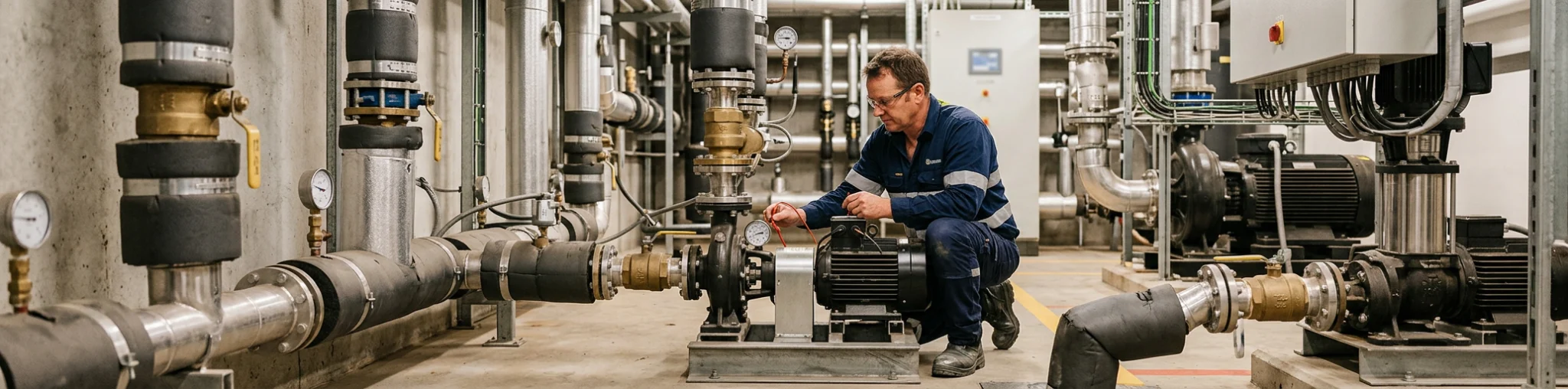
Hot water vanishes from the upper floors before dawn when the circulation pump has tripped, seized or started throwing air. Hotel and office loops do not forgive a unit that cannot hold flow against the return temperature and the static in the riser. We maintain these pumps across Perth plant rooms by checking impellers, seals, isolation valves and the air that collects at the high point. Our service keeps the loop moving so the calorifier is not fighting a dead riser. Leave the circulator until it screams and the building loses showers, kitchens and a Monday morning complaint list.
The pump sits on the return of the hot water loop. It keeps the pipework hot so tenants do not wait. When it stops, the calorifier or heat exchanger cannot keep up and the complaints start. Commercial building pump maintenance on these duties is mostly about catching wear before the loop goes cold.
How the Circulation Pump Sits in a Typical WA Plant Room
The unit is usually a small in-line or end-suction centrifugal on a packaged skid. Flow is low, head is modest, but run hours are continuous. We see both fixed-speed and VFD-driven sets. The VFD lets you drop speed at night when heat loss falls, which saves the mechanical seal and the motor bearings.
Suction is taken from the cooled return. Discharge feeds back into the storage or the heat exchanger. If the original installer ignored NPSH, the pump cavitates every time the loop temperature drops and the vapour pressure rises. You hear the gravel noise first, then the impeller starts pitting.
Packaged pump systems and controls keep the electrics and the hydraulics on one frame. That makes isolation cleaner when you have to pull the unit. Loose pumps bolted to the floor with separate starters are still common in older buildings and they take longer to lock out.
Early Signs You Catch on the Weekly Walk-Round
You do not need a shutdown to know the pump is struggling. Listen to the volute. A healthy circulation pump is almost silent. Rattle or a high-pitched whine means the impeller is hitting the casing or the bearings are dry.
Feel the motor casing with the back of your hand. It should be warm, not too hot to hold. If the fan shroud is blocked with dust the windings cook and the thermal overload trips. We see this after every summer when plant-room filters get neglected.
Check the mechanical seal drip. A few drops an hour is normal on a packed gland; a steady stream means the faces are gone. On a cartridge seal any visible leak is a call to isolate.
Look at the pressure gauges. If the differential has dropped 20 percent from the nameplate duty the impeller is worn or the suction strainer is blocked with scale. Perth water leaves calcium on everything.
Vibration at the baseplate tells you the coupling is out or the impeller is unbalanced. A cheap phone app is enough to log it. We keep a simple log on every site so the next fitter can see the trend.
Isolating the Pump Without Flooding the Plant Room
You close the suction and discharge isolation valves, open the drain, and crack the air cock. On a packaged set the valves are usually at the skid edge, which saves you crawling under pipework. Confirm zero energy at the VFD or starter before you touch terminals.
If the pump is vertical in-line you may need a chain block off the plant-room beam. We always check the lifting points on the motor stool first; some older casings crack if you lift on the wrong lug.
Once the unit is out, bag the flanges so debris does not fall into the loop. A rag in the pipe is not enough; scale flakes will travel and block the next fixture.
Mechanical Seal, Impeller and Volute Work We Actually Do
Most failures start at the seal. Carbon versus ceramic faces last longer in hot water than the cheap rubber bellows types. We replace the whole cartridge rather than trying to lap faces on site. The shaft sleeve usually needs replacing at the same time because the old seal has grooved it.
The impeller on a circulation pump is often a small brass or stainless casting. Scale builds on the vanes and the eye. A wire brush and a soak in inhibited acid bring most of them back, but if the vanes are thin you bin it. Running an eroded impeller drops flow and the loop temperature falls at the far risers.
Volute wear shows as a polished track opposite the impeller. If the clearance is more than a millimetre the pump will never make duty again. We measure it with a feeler and decide on the spot.
Bearings are usually sealed-for-life on these small motors. If they rumble you change the motor. Trying to repack a 0.75 kW unit on a ladder is not worth the time.
VFD, Controls and the Electrical Side
A VFD on a hot water circulation pump is there to follow the temperature drop in the loop. If the sensor is in the wrong place the drive hunts and the pump cycles. We check the analogue input and the PID settings before we blame the hydraulics.
Over-current trips usually mean the impeller is jammed with scale or the motor is single-phasing. Megger the windings while the unit is still warm; a reading that falls after it cools points to moisture in the terminal box hot water circulation pumps.
Earth leakage on these pumps is common because the plant room is humid. We fit a local isolator with a test button so you can prove the circuit without walking back to the main board.
If the original controls are a simple contactor and timer, consider a packaged pump system with its own controller. It gives you a run-hour log and a fault history that the next fitter can read.
NPSH, Air Binding and the Hydraulic Problems That Look Like Pump Failure
Low NPSH available is the silent killer on return-line duties. When the water in the loop is 65 °C the vapour pressure is already high. Add a dirty strainer or a high suction lift and the pump cavitates. You hear it, the flow drops, and the seal faces run dry.
Air binding happens when the pump is mounted above the water level in the calorifier or when a high point in the return has no air clock. The impeller spins in a pocket of steam and the motor current falls. You vent it, it runs for an hour, then it happens again.
APT Water always checks the static lift and the temperature before we condemn the pump. A simple calculation on the back of the job sheet tells you if the duty was wrong from day one.
When You Pull the Whole Set Versus Repairing in Place
If the motor and the wet end are both finished it is quicker to swap the packaged skid. We keep a few common duties on the truck for exactly this. The old set comes out, the new one drops in, flanges match, and the VFD parameters copy across.
In-situ repair is worth it when only the seal or the impeller is gone and the motor is still healthy. You save the lift and the reconnection time. We decide on the floor after the first inspection, not from the office.
Lead times on small circulation pumps are usually days, not weeks, but if the building cannot wait we can often re-impeller an existing casing while the new unit is coming.
Shutdown Windows and Talking to Building Management
You cannot kill hot water in a hotel at 8 a.m. We book the work for 1 a.m. or Sunday morning and we give the facilities manager a one-page method statement. Isolation points, estimated duration, and the back-up plan if the new pump does not prime first time.
If the plant room also houses fire hydrant or sprinkler pumps you confirm the fire isolation procedure first. The building’s fire safety plan is listed with DFES WA and you need to know whether a long electrical isolation affects those sets.
Tenants on the top floors feel the temperature drop first. We tell the manager to expect a two-hour window of cooler water at the far fixtures even after the pump is back on. That stops the angry calls while the loop re-heats.
After the Repair: Getting the Loop Back to Temperature
You fill slowly through the suction, vent at every high point, and bump the motor to check rotation. Then you run on hand until the discharge pressure matches the original duty. Only then do you put the VFD back in auto.
We log the new current, the differential pressure and the loop temperature at three fixtures. That becomes the new baseline for the next commercial building pump maintenance visit.
If the original pump was oversized we leave the VFD at a lower maximum speed. The loop still stays hot and the seal lasts twice as long.
Spares We Actually Carry and the Next Step You Can Take Tomorrow
On the truck we keep cartridge seals for the common in-line sizes, a couple of 0.55 kW and 0.75 kW motors, and a spare impeller for the most frequent duty. That covers 80 percent of the call-outs we get.
If you are standing in front of a failing unit tomorrow morning, isolate it, take a photo of the nameplate and the gauges, and send it. We can tell you in ten minutes whether it is a seal, an impeller or a full swap. That is the single practical next step that stops the loop going cold for another night.
When you need to match a replacement to the original duty, the process is laid out in choosing the right pump for commercial buildings. For the wider plant we look after these loops as part of our commercial building work.
When the replacement has to match the original duty, bring the nameplate and the loop temperature when you contact us, then pick a circulator that is the same job, not a near miss.